Best Electric Sauna Heater UK: Your Supply Decides It
Choosing the best electric sauna heater in the UK is a different exercise from choosing one in Finland, and almost every roundup ignores why. Finnish and Estonian homes commonly have a 400V three-phase supply. British homes almost never do. That single fact means a heater that is a straightforward install in Helsinki may need a 50 amp fuse and 10mm² cable in a British house, which is often more than the property can give it. Work out what your supply will carry first, then pick the heater, because doing it the other way round is how people end up with an expensive box they cannot legally energise.
The number that actually constrains you
Take Harvia’s Vega BC range, which is the most widely sold conventional wall heater in the UK, and look at the same specification across three outputs. All figures are Harvia’s own, from their product pages.
| Model | Output | Room volume | Stones | 230V single phase | 400V three phase |
|---|---|---|---|---|---|
| Vega BC45 | 4.5 kW | 3 to 6 m³ | 20 kg | 1 x 20 A, 3 x 2.5mm² | 3 x 10 A, 5 x 1.5mm² |
| Vega BC60 | 6.0 kW | 5 to 8 m³ | 20 kg | 1 x 35 A, 3 x 2.5mm² | 3 x 10 A, 5 x 1.5mm² |
| Vega BC90 | 9.0 kW | 8 to 14 m³ | 20 kg | 1 x 50 A, 3 x 10mm² | 3 x 16 A, 5 x 2.5mm² |
Read the last two columns. On three phase, going from 4.5 kW to 9 kW takes you from a 10 amp fuse to a 16 amp fuse and from 1.5mm² to 2.5mm² cable, which is a trivial difference. On single phase, the same step takes you from 20 amps to 50 amps and from 2.5mm² to 10mm² cable.
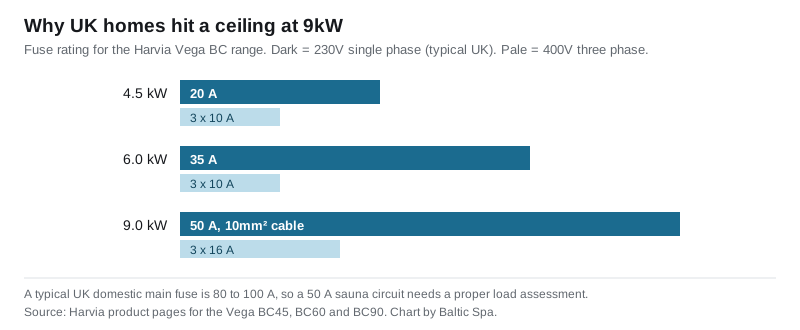
A typical UK domestic supply has an 80 or 100 amp main fuse. A 50 amp dedicated circuit for a sauna, on top of a shower, an oven and everything else, is a genuine load assessment question rather than a formality. Your electrician may well come back and say the answer is a supply upgrade, which is a DNO job with a lead time and a cost that dwarfs the heater.
So the practical UK ladder is:
- Up to about 4.5 kW: straightforward for most homes. A 20 amp radial circuit is unremarkable.
- 6 kW: viable in many homes, at 35 amps. Worth a load assessment, particularly with an electric shower and an EV charger already fitted.
- 8 to 9 kW: the point at which the supply, not the sauna, becomes the deciding factor. Check before you specify the room, because a 12 m³ sauna needs this and there is no way round it.
- Above 9 kW single phase: in practice, not a domestic proposition without three phase.
Our sauna heater electrical supply calculator works through the load question, and the sauna heater size calculator sizes the output to the room.
Size the heater to the room, then check the room
Manufacturers publish a room volume range for each output, and the ranges are narrower than people expect. Harvia’s Vega BC60 at 6 kW covers 5 to 8 m³. That is a sauna roughly 2m x 2m x 2m at the top end. The BC90 at 9 kW covers 8 to 14 m³.
Two adjustments that catch people out, and both push you up a size:
- Uninsulated surfaces add load. Glass, tile, brick, concrete and exposed log all absorb and radiate heat in a way that insulated timber panelling does not. A large glass door and a glass front wall, which is what most people want visually, meaningfully increases the output you need for the same volume.
- The range is a range for a reason. A heater at the very top of its stated volume band will get there, eventually, and will struggle to recover after a few ladles of water. Sitting one step up from the minimum is more comfortable than sitting at the maximum.
Our page on what size sauna heater you need works through the calculation properly, including the glass adjustment.
Stone mass is what separates heaters at the same kW
Two 6 kW heaters put the same energy into the room. What differs is how much of it is stored in stone, and stone mass is what determines the character of the steam.
A conventional wall heater like the Vega BC carries around 20 kg of stones. A pillar heater like the Harvia Cilindro carries substantially more, in the region of 80 kg on the larger models, and the HUUM Drop carries around 55 kg in a wall-mounted form. That difference is not marketing.
What more stone buys you:
- Softer löyly. Water hitting a large, deeply hot stone mass produces a gentler, more enveloping steam than water hitting a thin layer of stones over exposed elements.
- Recovery between ladles. A small stone mass cools quickly when you throw water. A large one carries on producing steam through a whole session rather than needing to catch up.
- More stable temperature once up to heat, because the stones buffer the element cycling on and off.
What it costs you:
- Longer heat-up. A heavy stone mass takes longer to reach temperature. The trade is a slower start for a better session.
- More electricity per session if you use the sauna infrequently, because you are heating more thermal mass each time.
- Space and weight. A floor-standing pillar heater needs floor area a wall heater does not, and the loaded weight needs a floor that can take it.
If you use the sauna two or three times a week for long sessions, stone mass is the upgrade worth paying for. If you use it for a quick 25 minutes after work, a conventional wall heater with fast heat-up suits you better and the pillar heater’s advantage never materialises.
The controls decision
Heaters split into two types and the distinction matters more than the brand.
Integrated controls, like the switches on the Vega BC, mean a timer and thermostat on the heater itself. Simpler, cheaper, and it means walking into a cold sauna to switch it on.
Separate control unit, the E-suffix versions of the same heaters, means a wall panel outside the sauna and, on most modern systems, an app. The heater costs less on its own but the control unit is a significant extra. What you get is the ability to start the sauna from the house or from the car, which in practice is the difference between using it three times a week and using it once.
The E versions exist precisely because this is a real decision. If you are installing in an outbuilding or garden room, remote start is close to essential, because nobody walks to the bottom of the garden to press a button and walks back an hour later.
Installation points people find out too late
- It must be installed by a qualified electrician and notified under Part P of the building regulations. A sauna heater is a fixed appliance in a special location, and this is not a DIY circuit.
- Safety clearances are non-negotiable and small. Harvia specifies 30mm front and 50mm side clearance for the Vega BC60, but 1.1m to the ceiling. That ceiling figure is the one that catches garden-room installs with low ceilings.
- Minimum assembly height matters too. Harvia specifies 2m minimum for the Vega BC60, so the heater cannot simply be positioned wherever the bench layout suggests.
- Buy the right stones and load them properly. Stones must be the type specified, loaded loosely so air can pass between them, not packed tight. Packed stones restrict airflow, overheat the elements and shorten the heater’s life. Re-stack them annually, because stones crumble.
- Check the warranty terms for the UK. Some manufacturer warranties are conditional on installation by an approved installer, and a heater bought from a European site and fitted by a local electrician may not be covered here.
For the wider picture including wood-burning options, see our sauna heater guide and our roundup of the best sauna heaters in the UK.
Frequently asked questions
What size electric sauna heater do I need? Match the output to the room volume using the manufacturer’s stated range, then increase it if the sauna has significant glass, tile, brick or exposed log surfaces. As a reference point, Harvia rates its 4.5 kW Vega BC45 for 3 to 6 m³, the 6 kW BC60 for 5 to 8 m³ and the 9 kW BC90 for 8 to 14 m³.
Can I run a 9kW sauna heater on a normal UK domestic supply? Sometimes, but it needs checking rather than assuming. On 230V single phase Harvia specifies a 50 amp fuse and 10mm² cable for the 9 kW Vega BC90. Against a typical 80 or 100 amp main fuse, that requires a proper load assessment, and in some homes the answer will be a supply upgrade.
Do I need three-phase power for an electric sauna? Not for smaller heaters, and most UK homes will never have it. Three phase makes larger outputs trivial, since a 9 kW heater needs only 3 x 16 A fuses on 400V three phase against 50 A on single phase. Without it, 9 kW is the practical domestic ceiling and 6 kW is the comfortable one.
Does more stone capacity make a better sauna heater? For steam quality, yes. A heater carrying 55 to 80 kg of stones produces softer löyly and recovers better between ladles of water than one carrying 20 kg at the same kW. The trade-offs are a longer heat-up time and more energy per session, so it suits frequent, longer sessions rather than quick ones.
Should I get a heater with integrated controls or a separate control unit? Separate, if the sauna is in a garden room or outbuilding, because remote or app start is what makes it get used. Integrated controls are cheaper and simpler and are fine for an indoor sauna you walk past anyway. The separate control unit is a meaningful extra cost, so factor it in when comparing heater prices.
Can I install an electric sauna heater myself? No. It is a fixed electrical installation in a special location and must be installed by a qualified electrician and notified under Part P. Beyond the legal position, the clearances, cable sizing and earthing arrangements are specific, and a heater installed outside the manufacturer’s instructions will not be covered by its warranty.
More from Baltic Spa
 Reviews
The Best Public Saunas in London for 2026, Tested and Ranked
We tested and ranked the best public saunas in London for 2026, from £9.50 community baths to Canary Wharf's 60-person contrast therapy hall.
 Infrared Saunas
Infrared Sauna Blankets: How They Work and Who They Suit
How an infrared sauna blanket works, what the layers and EMF claims really mean, who they suit and who should avoid one, from an evidence-first UK guide.
Sauna Stones Calculator: How Many Kg of Stones Do You Need?
Free sauna stones calculator: enter your electric heater's kW or your wood stove size and get the recommended stone weight in kg, plus how many boxes to buy.