Sauna Heater kW Sizing: Why 9kW Is Your UK Ceiling
Choosing a sauna heater in the UK is two decisions that people usually merge into one and get wrong as a result. The first is thermodynamic: how many kilowatts does this cabin need? The second is electrical: what will the supply to your house actually carry? Get the kW right and the supply wrong and you have bought a heater your electrician cannot connect.
The sizing arithmetic is simple and published by every manufacturer. The supply constraint is the British bit, it is not in the Finnish brochures, and it is the reason most domestic saunas in this country land at 8 or 9kW regardless of what the room would ideally take.
The sizing rule, and the part everyone forgets
The base rule across the industry is 1kW of heater power per cubic metre of sauna volume. Measure the internal length, width and height in metres, multiply, and that is your starting kW.
A 2m by 2m cabin with a 2.1m ceiling is 8.4m³, so roughly an 8.4kW heater, which in practice means the 9kW model.
The part that catches people is the surface correction. Insulated timber holds heat; glass, stone, brick, concrete and solid log do not. Harvia’s guidance is that one square metre of glass, stone or similar uninsulated surface adds the equivalent of about 1.2m³ to the room volume.
Apply that and a fashionable cabin changes shape fast. Take the same 8.4m³ room and give it a full-height glass front of, say, 3m², and you are adding roughly 3.6m³ of effective volume. Now you need about 12kW for a room whose raw dimensions said 8.4. That single line of arithmetic explains most disappointed sauna owners in Britain: they bought the heater for the box and then specified a glass door and a picture window.
Two more points from the same guidance worth taking seriously:
- The calculated figure is a minimum, not a target. If anything, round up to the next model.
- Undersizing damages the heater. A heater that is too small has to run longer and harder to reach temperature, which shortens its life. Buying small to save money on the unit costs more over the life of it.
Work out your own room volume with our sauna size guide before you look at any heater at all.
The British ceiling: single-phase supply
Here is the constraint that global sizing guides ignore.
Most UK homes have a single-phase 230V supply, and the practical maximum sauna heater on it is around 9kW. That is not a manufacturer limit, it is an electrician’s comfort zone: a 9kW heater on single phase draws roughly 39A, which needs a substantial dedicated circuit and eats a serious chunk of your available household load.
The same 9kW heater on a 400V three-phase supply draws only about 13A per phase, which is why continental installations happily specify 10, 12 and 15kW units. Three-phase is common in European homes and uncommon in British ones.
So the sequence matters:
- Calculate the kW the room needs, including the glass correction.
- Check what your supply can give. If the answer is more than about 9kW and you are on single phase, you have a decision to make before you buy anything.
- If the room genuinely needs more, your options are to reduce the demand (less glass, better insulation, a lower ceiling) or to look at a three-phase supply upgrade, which involves your Distribution Network Operator and is driven by your whole-house load rather than the sauna alone. That is a separate project with its own timescale and cost.
The cheapest fix is almost always at step 3a. Lowering the ceiling from 2.4m to 2.1m in a 2m by 2m cabin removes 1.2m³ of volume and improves the sauna, because the heat you are paying for sits at head height rather than above it.
What the wiring has to be, and why it is not a DIY job
A sauna is a special location under BS 7671 Section 703, with its own rules. This is worth knowing before you get a quote, because an electrician who has not done one before may not price it correctly.
The requirements that matter:
- A dedicated radial circuit, sized to the heater’s data plate rating, typically 20A to 40A for domestic units, protected by an RCBO.
- Heat-resistant cable inside the room. Zone 3 cable insulation and sheathing must withstand at least 170°C, so standard PVC at 70°C and XLPE at 90°C are both non-compliant. Silicone rubber rated 170 to 180°C is the normal choice throughout the sauna room.
- Zones. Zone 1 is the heater volume out to 0.5m from its surface. The Zone 2 and 3 boundary is a horizontal plane 1.0m above the floor. Zone 3 runs from there up to the cold side of the wall and ceiling insulation.
- Ingress protection of at least IPX4, or IPX5 where jet washing is expected.
- Equipment in Zone 3 must withstand at least 125°C.
- 30mA RCD protection for the sauna circuits, with the heater itself exempt unless the manufacturer says otherwise.
Nothing on that list is exotic, but all of it is specific, and none of it is satisfied by running a cooker cable to a wall box. Budget for a qualified electrician and the certificate.
Choosing the heater itself
Once the kW is settled, the remaining choices are about how you want to use it.
Wall-mounted or floor-standing
Wall-mounted is the default for domestic cabins: compact, easy to fit, and it keeps the floor clear. Every model has published minimum clearances to timber and to the bench, and they differ considerably between manufacturers and outputs. Follow the specific manual, not a general rule, because these are the distances that cause fires.
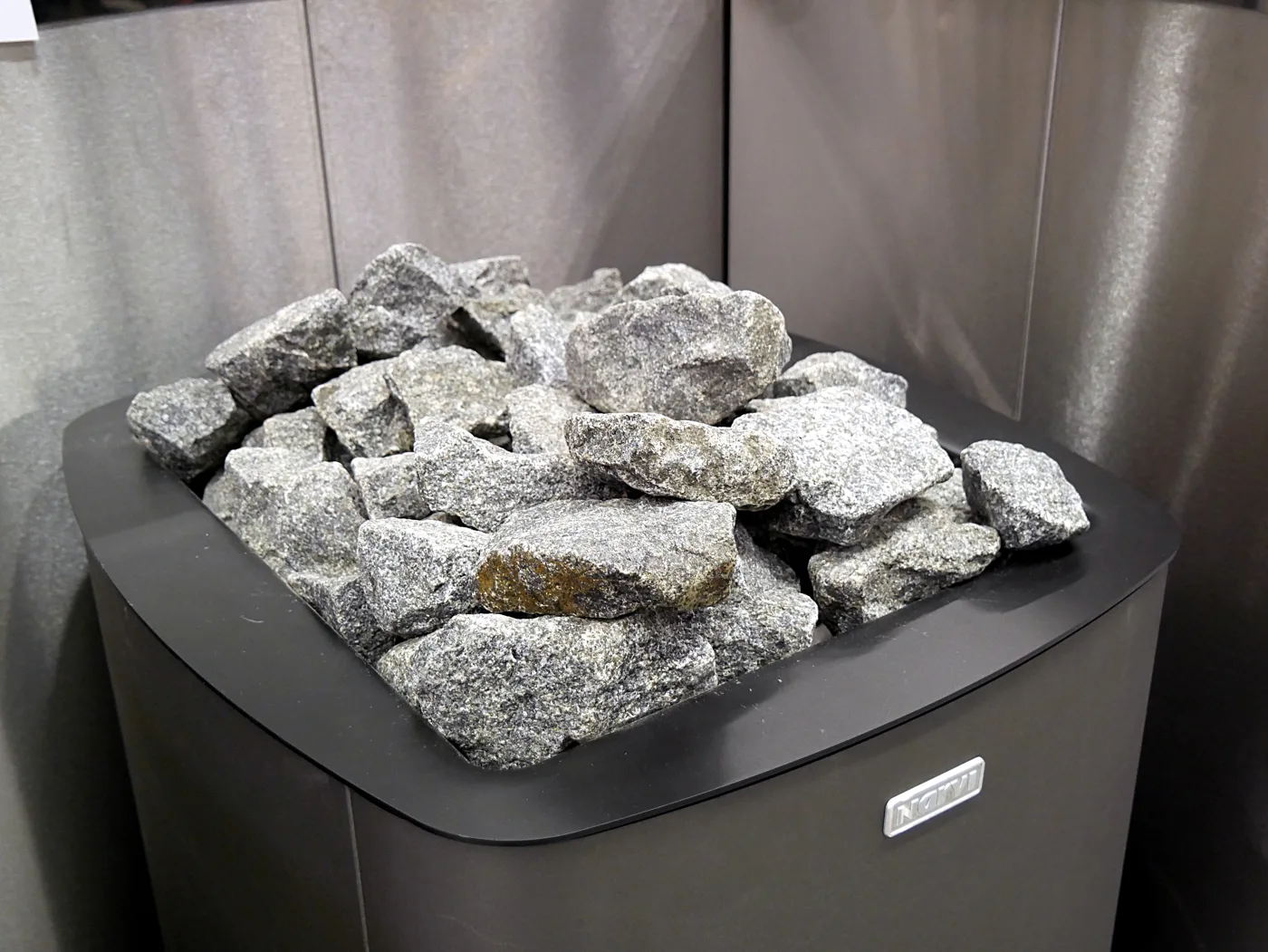
Floor-standing and pillar heaters hold far more stone, which is the real variable in how a sauna feels. More stone means a softer, more sustained heat and much better löyly when you throw water. If the cabin has the space, this is where the money makes a noticeable difference.
Stone capacity is the spec nobody compares
Two heaters of identical kW can produce completely different saunas depending on how much stone they hold. The stones are the thermal store; the elements only heat them. A heater with a large stone volume recovers faster after water, holds a gentler heat and feels less like standing in front of a fan heater.
If you are comparing two models at the same kW and price, compare the stone capacity in kg. It is usually the more meaningful difference.
Integrated controls or separate panel
Integrated controls on the heater body are cheaper and fine for a cabin you walk into and switch on.
A separate control panel, mounted outside the sauna, allows timers, remote start and precise temperature setting, and is the sane choice for an outdoor cabin you would rather not stand in while it warms up. Modern panels increasingly offer app control, which for a garden sauna in a British winter is more useful than it sounds.
Electric or wood-fired
Electric is simpler, controllable and works anywhere you have supply. Wood-fired needs no electrics at all, gives a heat that many people prefer, and brings a flue, a hearth, building regulations and, in a smoke control area, restrictions on what you can burn. Our wood-fired versus electric comparison and wood-fired buying guide go into that properly.
For specific models at each size, see our best sauna heaters roundup.
Five sizing mistakes worth avoiding
Specifying the glass after the heater. The glass front goes on the drawing before the heater is chosen, or the correction never gets applied.
Measuring external dimensions. Sauna volume is the internal cabin, inside the cladding. Using the external footprint of a barrel or cabin overstates the volume and oversizes the heater.
Ignoring an uninsulated wall. A sauna built against a masonry garage wall, or with an original brick wall left exposed for looks, carries the same correction as glass. It is a heat sink.
Building the ceiling too high. Heat stratifies. A ceiling much above 2.1 to 2.2m puts your bought heat above the top bench and costs kW to no benefit.
Forgetting the door. A glass door is glass. A typical full-glass sauna door is around 1.6m² of uninsulated surface on its own, which is nearly 2m³ of added effective volume before you add a window.
Frequently asked questions
What size sauna heater do I need in the UK? Start with 1kW per cubic metre of internal cabin volume, then add the equivalent of about 1.2m³ for every square metre of glass, stone or other uninsulated surface. Round up to the next available model. Then check your electrical supply can carry it, because that often becomes the binding constraint.
Can I fit a 12kW sauna heater in a normal UK house? Usually not without a supply upgrade. Most British homes are single-phase 230V, where the practical ceiling is around 9kW. A 12kW heater is straightforward on a 400V three-phase supply, which is uncommon in UK housing, and adding three-phase means a project with your Distribution Network Operator.
Does a glass door really change the heater size? Yes, more than people expect. A full-glass sauna door is roughly 1.6m² of uninsulated surface, which adds close to 2m³ of effective volume. Add a picture window as well and a room that measured 8m³ can need a heater sized for 12m³.
What electrical work does a sauna heater need? A dedicated radial circuit on an RCBO, sized to the heater’s rating and typically 20 to 40A, with heat-resistant cable inside the room rated to at least 170°C, IPX4 or IPX5 equipment, and 30mA RCD protection on the sauna circuits. It falls under BS 7671 Section 703 and needs a qualified electrician.
Is it better to oversize or undersize a sauna heater? Oversize, within reason. Manufacturers describe the calculated figure as a minimum, and an undersized heater runs longer and hotter to reach temperature, which shortens its service life as well as your patience. Going one model up is the safer error.
How much do sauna stones matter compared to kW? A great deal, and they are rarely compared. The stones store the heat; the elements only charge them. Two heaters at the same kW can feel entirely different, and the one with the greater stone capacity will give a softer heat and recover faster after you throw water.
More from Baltic Spa
 Reviews
The Best Public Saunas in London for 2026, Tested and Ranked
We tested and ranked the best public saunas in London for 2026, from £9.50 community baths to Canary Wharf's 60-person contrast therapy hall.
 Infrared Saunas
Infrared Sauna Blankets: How They Work and Who They Suit
How an infrared sauna blanket works, what the layers and EMF claims really mean, who they suit and who should avoid one, from an evidence-first UK guide.
Sauna Stones Calculator: How Many Kg of Stones Do You Need?
Free sauna stones calculator: enter your electric heater's kW or your wood stove size and get the recommended stone weight in kg, plus how many boxes to buy.