Barrel Saunas Explained: Pros, Cons and What to Look For
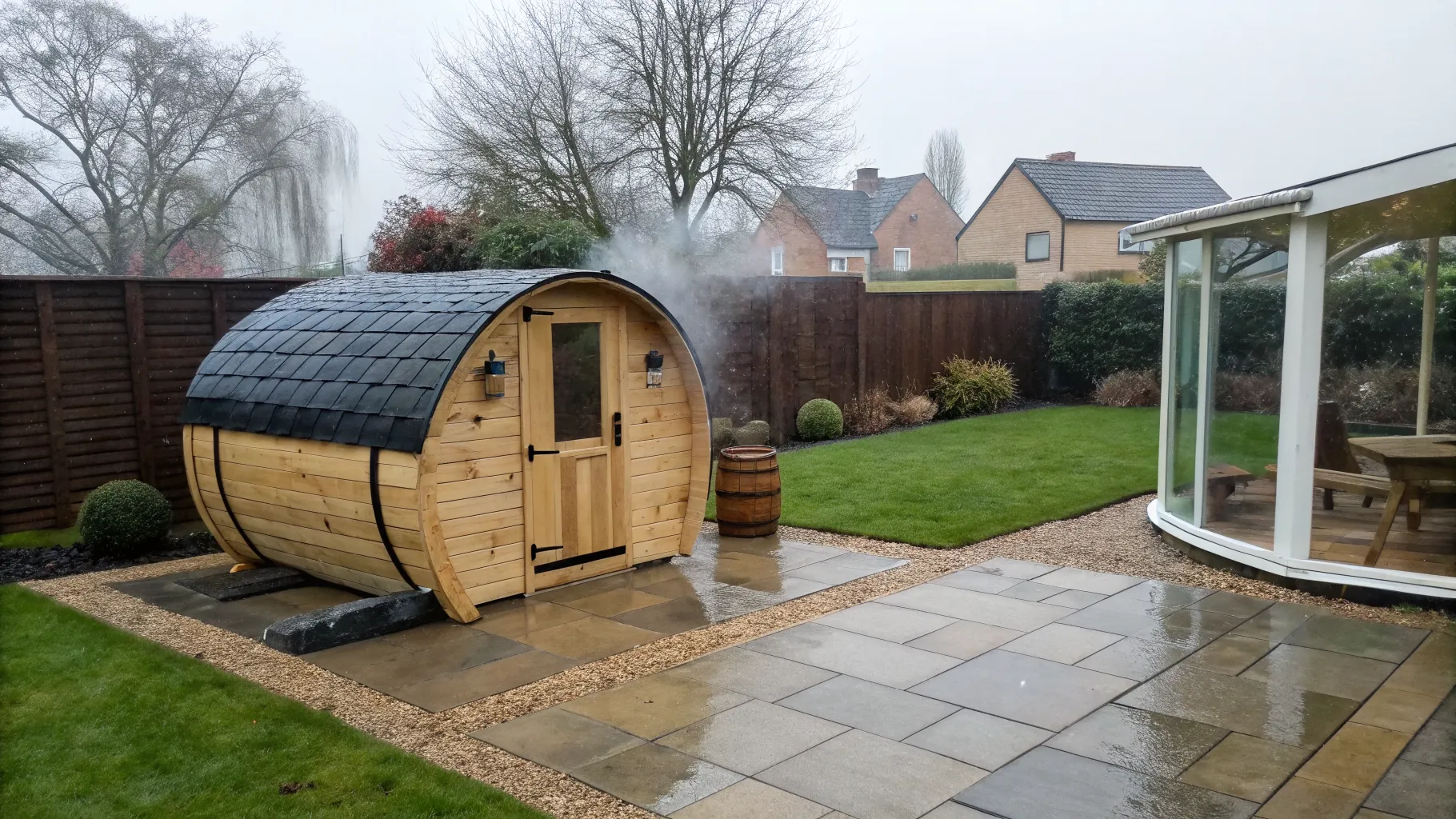
A barrel sauna is the cheapest sensible route to a proper outdoor sauna in a British garden: expect around £3,000 to £4,000 for an entry spruce kit, £4,500 to £5,500 for a decent thermowood four-seater, and £6,000 plus for the bigger or cedar-clad versions. The shape heats fast and looks the part, but it comes with real trade-offs that retailer blogs gloss over: a single bench level, no insulation, and a quicker cool-down than a built cabin. This guide covers how they work, what they cost to run, the planning and smoke rules, and exactly what separates a good kit from a cheap one.
How a barrel sauna actually works
The barrel shape is not just styling. A cylinder holds roughly 23 per cent less air than a square room with the same floor area, so the heater has less volume to warm, and the curved ceiling pushes hot air around in a continuous convection loop rather than letting it pool flat against a ceiling. The practical result: a garden-sized barrel reaches session temperature in 30 minutes to an hour depending on the heater and the weather, the range both Finnmark Sauna and Layzee Living quote for their standard models, with the biggest barrels taking longer.
The structure itself is simple. Staves of softwood, usually 40 to 45mm thick on quality kits, slot together around two circular end walls and are pulled tight by stainless steel bands. Most kits arrive flat-packed and go up in a day or two with two people. There is no frame, no cavity and, on almost every barrel sold in the UK, no insulation. That single-skin construction is the source of both the low price and the biggest drawback, which we will get to.
If you are still deciding between sauna types in general, start with our home sauna buying guide, and if you are weighing a barrel against an infrared cabin, the traditional versus infrared comparison covers that fork in the road.
What a barrel sauna costs in the UK
Prices in mid 2026 fall into three rough bands:
| Band | What you get | Typical spend |
|---|---|---|
| Entry | Raw spruce kit, thinner staves, heater often extra | Around £3,000 to £4,000 |
| Mid | Thermowood, 40mm plus staves, 4 person, branded heater option | Around £4,500 to £5,500 |
| Premium | 280 to 330cm lengths, cedar cladding, changing porch | £6,000 and up |
As a concrete reference point, Layzee Living sells a 220cm thermowood barrel (2050mm diameter, 2200mm long, up to four people) for a little under £5,000 at the time of writing, with 42mm stave walls, 28mm front and rear walls, a bitumen shingle roof, a 10 year structural warranty and UK flat-pack delivery included outside Northern Ireland and the Scottish Highlands and Islands. The heater is a choice between a Harvia M3 wood-fired stove and a Harvia Cilindro PC70 6.8kW electric. That spec sheet is a useful benchmark even if you buy elsewhere: it is roughly what “good mid-range” looks like.
Budget on top for a base (paving slabs, a concrete pad or a gravel grid, dead level and solid), and for an electrician if you go electric. A 6.8kW heater is hardwired on its own supply, not plugged into a 13 amp socket, and that work falls under Part P of the Building Regulations, so it needs a qualified electrician. The two most common owner regrets are predictable: buying the cheapest kit and replacing it within a couple of years, and never pricing the electrics or the delivery access before ordering.
Running costs and the insulation problem
A full session including heat-up uses roughly 5 to 9 kWh on an electric heater, which works out at somewhere between £1 and £3 per session at typical UK rates. Two or three sessions a week is pocket-money territory; daily use in January is not nothing. You can put your own tariff into our sauna running cost calculator for a number that matches your bill.
Here is the part retailer pages skip. Because the walls are a single skin of 40 to 45mm timber with no insulation, a barrel loses heat continuously while you use it and cools fast between rounds. In a British winter that means the heater works harder to hold temperature, the gap between rounds costs you more energy than it would in an insulated cabin, and a windy February evening will noticeably stretch the heat-up time. None of this makes a barrel a bad buy; the fast heat-up from the small air volume offsets a lot of it for a single session. But if you plan long multi-round sessions all winter, an insulated cabin sauna will be cheaper to run and more stable, and you should weigh that before the shape wins you over.
Wood-fired or electric, and the smoke control trap
Electric is the default for most UK gardens: clean, controllable, and a Harvia Cilindro PC70 at 6.8kW (rated by Harvia for 6 to 10 cubic metres) suits the typical four-seater barrel. Harvia’s general sizing guidance is about 1kW per cubic metre of sauna volume, with each square metre of glass adding the equivalent of 1.2 cubic metres, and you should avoid a heater running at the extreme ends of its stated range. Our heater size calculator does the arithmetic for you.
Wood-fired is the romantic option and the right one if your garden has no easy power run. The standard stove is the Harvia M3, rated by Harvia for rooms of 6 to 13 cubic metres. But check your address first. Large parts of urban Britain are Smoke Control Areas, and the gov.uk smoke control rules draw a line that catches sauna stoves: open outdoor appliances like barbecues and chimineas are exempt, but an appliance flued through the roof of a building or structure must either burn an authorised fuel or be a Defra-exempt appliance. Most sauna stoves are not on the exempt list. Breaching the rules risks a fine of up to £300 for smoke and up to £1,000 for burning unauthorised fuel. If you are in a city, assume electric unless your council confirms otherwise.
Two further wood-fired points. Logs sold in quantities under 2 cubic metres must be certified “Ready to Burn” at under 20 per cent moisture under the Defra scheme, so buy certified or season your own properly. And the flue and stove installation falls under Approved Document J of the Building Regulations: use a HETAS-registered installer or get building control sign-off.
Planning permission and where it can go
Most barrel saunas need no planning permission. The Planning Portal lists saunas explicitly as garden outbuildings, and under permitted development the rules are: single storey only; a maximum height of 2.5 metres if any part sits within 2 metres of a boundary; otherwise 4 metres for a dual-pitched roof or 3 metres for other roof shapes; no more than half the garden covered by outbuildings; and nothing forward of the principal elevation. The full detail is on the Planning Portal outbuildings page.
The catches: a 2050mm diameter barrel plus its shingle roof can sit close to the 2.5 metre limit, so measure before you commit to a spot near the fence. On designated land (National Parks, Areas of Outstanding Natural Beauty, conservation areas, World Heritage Sites) the rules tighten, with a 10 square metre cap if the building is more than 20 metres from the house. Flats and maisonettes have no permitted development rights at all. We found no changes to these rules for 2026, but check your own council’s planning pages before ordering; it takes ten minutes and removes the risk entirely.
Will it rot? Wood choice and lifespan
In UK damp, the wood choice matters more than anything else on the spec sheet.
- Raw spruce is the cheapest and the reason entry kits start around £3,000. Untreated, it warps and rots in British weather, so it needs regular exterior treatment from day one.
- Thermowood is timber, often spruce, heat-treated in a steam-controlled kiln at around 200 degrees Celsius, which drives out the sap and resin. It is dimensionally stable, rot-resistant and a slightly better insulator. For a sauna you want standing in 15 years, this is the pick.
- Western red cedar is naturally durable and smells wonderful, and it is priced accordingly at the top of the market.
Whatever the wood, the top staves take the weather first and rot first, so a bitumen shingle roof over the top half is a must-have, not an optional extra. Treat any kit sold without one as incomplete.
Realistic lifespans: 10 to 20 years for a typical barrel, with 20 to 30 achievable from thermowood plus maintenance. Electric heaters last around 10 to 15 years and are straightforward to replace.
The cheap kit versus good kit checklist
Importers sell barrels that look identical in photos and behave very differently after three winters. Check these before paying:
| What to check | Budget kit | Quality kit |
|---|---|---|
| Stave thickness | 28mm | 40 to 45mm |
| Wood | Raw spruce | Thermowood or cedar |
| Roof | Bare staves | Bitumen shingles included |
| Bands | Plain steel | Stainless steel |
| Heater | Unbranded | Harvia or HUUM |
| Warranty | 1 to 2 years | 10 years structural |
| Door | Acrylic or thin glass | Tempered glass |
Also check the front and rear wall thickness (28mm is common even on good kits, but it should be stated, not hidden) and whether delivery actually reaches your garden: a flat-pack fits through a side gate, a pre-built barrel may need a crane.
So should you buy one?
Buy a barrel if you want a real löyly-capable outdoor sauna for the least money, you mostly do single sessions rather than long multi-round evenings, and you like the look. Skip it if you want tiered benches with a hot upper level (a barrel has one bench height, so everyone sits at the same temperature), if headroom matters to a tall household (it drops sharply away from the centre line), or if you plan heavy winter use, where an insulated cabin earns its higher price back in running costs. Our best home saunas in the UK round-up sets barrels alongside the cabin and indoor alternatives if you want to compare across types before you spend.
Frequently asked questions
Do I need planning permission for a barrel sauna? Usually not. Saunas count as garden outbuildings under permitted development, provided they are single storey, no taller than 2.5 metres within 2 metres of a boundary, cover less than half the garden and sit behind the front of the house. Designated land has tighter limits and flats have no permitted development rights, so check the Planning Portal and your local council first.
How long does a barrel sauna last in British weather? A typical barrel lasts 10 to 20 years, and a thermowood barrel with a shingle roof and basic maintenance can reach 20 to 30. Raw spruce left untreated is the failure case: it warps and rots in UK damp. Electric heaters last around 10 to 15 years and can be replaced.
How much does a barrel sauna cost to run? A full electric session including heat-up uses roughly 5 to 9 kWh, which is somewhere between £1 and £3 at typical UK rates. Because the walls are uninsulated single-skin timber, winter sessions sit at the top of that range and the sauna cools quickly between rounds.
Can I have a wood-fired barrel sauna in a city? Often not without restrictions. In a Smoke Control Area, a stove flued through the roof of a structure must burn authorised fuel or be a Defra-exempt appliance, and most sauna stoves are not exempt. Fines run up to £300 for smoke and £1,000 for unauthorised fuel, so check gov.uk and your council before choosing wood-fired.
Do barrel saunas need a base? Yes. The barrel must sit on a level, solid surface: paving slabs, a concrete pad or a compacted gravel grid all work. An uneven base twists the staves, opens gaps and shortens the life of the whole structure.
What size heater does a barrel sauna need? Harvia’s guidance is roughly 1kW per cubic metre, with each square metre of glass counting as an extra 1.2 cubic metres. A standard four-seater barrel of around 7 to 9 cubic metres suits a 6 to 6.8kW electric heater such as the Harvia Cilindro PC70, or a Harvia M3 if you go wood-fired. Avoid any heater running at the very edge of its stated volume range.
More from Baltic Spa
 Reviews
The Best Public Saunas in London for 2026, Tested and Ranked
We tested and ranked the best public saunas in London for 2026, from £9.50 community baths to Canary Wharf's 60-person contrast therapy hall.
 Infrared Saunas
Infrared Sauna Blankets: How They Work and Who They Suit
How an infrared sauna blanket works, what the layers and EMF claims really mean, who they suit and who should avoid one, from an evidence-first UK guide.
Sauna Stones Calculator: How Many Kg of Stones Do You Need?
Free sauna stones calculator: enter your electric heater's kW or your wood stove size and get the recommended stone weight in kg, plus how many boxes to buy.